
Introduction
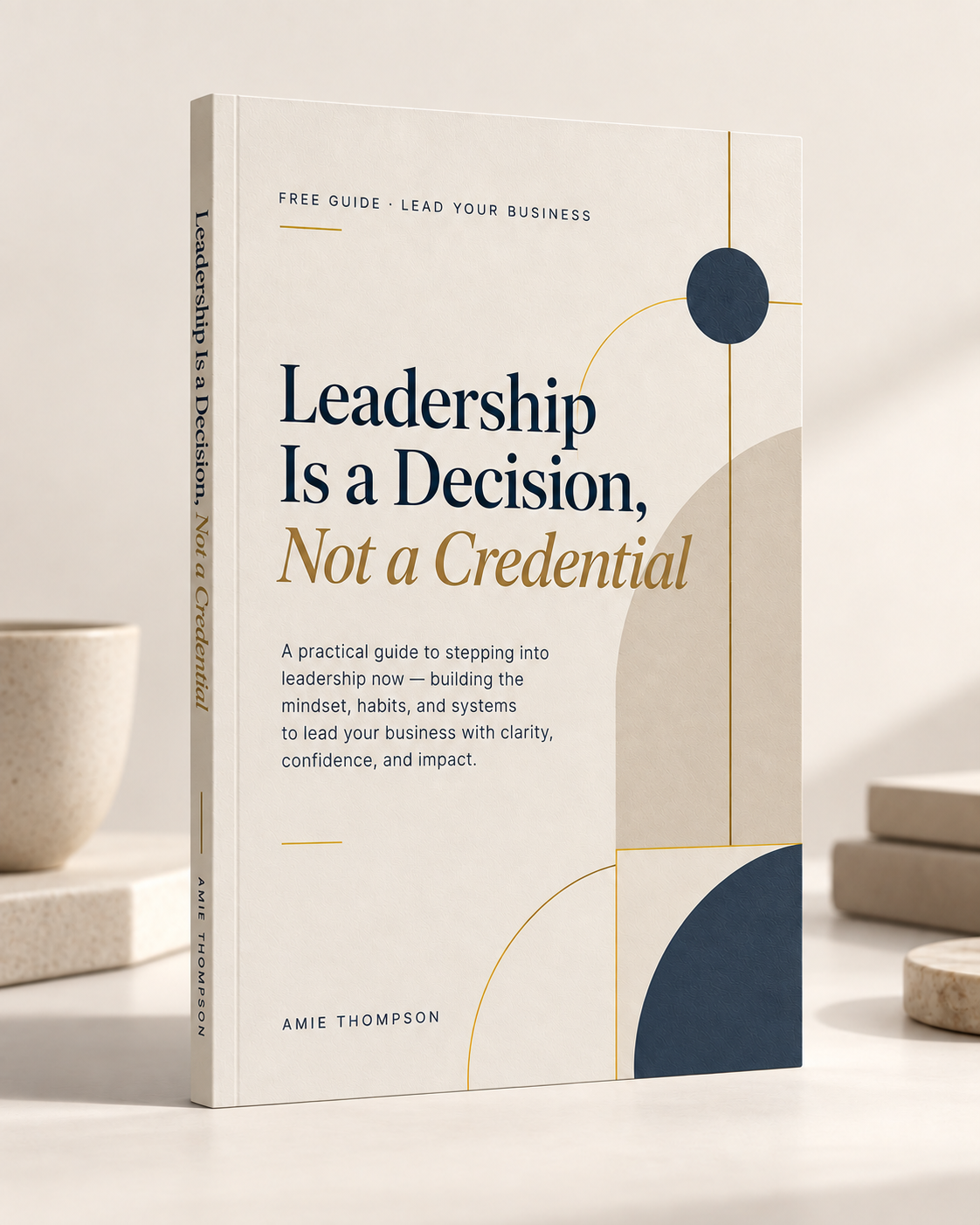
Leadership Is a Decision
Most people were taught that leadership is something you earn through tenure, titles, or someone else's approval. That model is broken.
Leadership is influence. It is how you show up, communicate, make decisions, and make people feel. This guide offers a practical framework for the four behaviors that define it.
You do not need a stage. You need a standard for yourself.
Section 02
Four Behaviors That Define Leadership
01 Ownership
Take the outcome
Treat the work and its results as yours, fully and without hedging.
02 Consistency
Hold the standard
Show up to the standard you set even when no one is watching.
03 Influence
Earn the trust
Build trust through quality, clear communication, and follow-through.
04 Decision-making
Move with incomplete information
Clear open loops and move the business forward.
Section 03
Leading from Where You Are Right Now
Leading from where you are means taking ownership of your sphere of influence, whatever size it is. Speak up when something is not working, flag problems early, and set a standard others can see.
Ownership is asking what success looks like before starting. It is following through without being chased and bringing a solution with the problem.
Where are you waiting for permission to do something you could do?
What would taking more ownership look like in your work?
Where have you been completing tasks without considering the outcome?
Section 04
The Operator-to-Leader Shift
The shift from operator to leader is a thinking shift practiced through small, deliberate choices.
Waiting for the right moment
Making the call with what is available
Explaining decisions to justify them
Announcing decisions and standing behind them
Lowering the price when a client hesitates
Holding the price and letting the client decide
Keeping a difficult client
Ending a relationship the business cannot sustain
Waiting for permission
Acting as the owner
Section 05
Making Decisions Like a Leader
Leaders make decisions with incomplete information. The goal is to develop the judgment to move wisely in uncertainty. Separate what you know from what you assume, choose the next decision, and build checkpoints to adjust.
Good leaders are wrong sometimes. They make the call, own the outcome, and adjust.
Are you waiting for more information or more certainty?
Is the deeper concern being wrong or what others will think?
What would it look like to decide with 70 percent of the information?
Section 06
Leading Your Business as an Entrepreneur
Self-leadership comes first
How you manage your mindset, decisions, time, and energy will determine your business's ceiling. Every delayed conversation and unheld standard appears in the business eventually.
Confidence follows action
Confidence is a result of leadership. The work is done by the person who acts before certainty arrives.
Growth is not a sprint
Leave with one decision or behavior you will practice today.
Section 07
Leading by Example and Why Consistency Compounds
People watch what you do more than they listen to what you say. Quality work, steadiness under pressure, and follow-through create trust. A hundred small moments build a reputation.
What behaviors are you modeling now?
Where is there a gap between what you say matters and how you operate?
Who may be watching how you handle things?
Your turn
Reflect and Act
Where are you operating like an employee instead of the owner?
What decision has been open longest, and what is stopping you?
Which Leader's Standard behavior needs attention now?
What action will you take in the next 48 hours?
About the author
Amie Thompson
Entrepreneur & Business Strategist
Amie Thompson is an entrepreneur and business strategist who helps small business owners and early-stage founders build visibility, sell with confidence, and put AI to work.
Read more about Amie or continue with Making the Shift from Operator to Leader.