
Introduction
A Business That Runs on Your Memory Isn't a Business
Most solopreneurs hit the same wall. Things are working, clients are coming in, revenue is moving, and then it gets harder instead of easier. The more the business grows, the more it demands from you personally. Every task, every decision, every client interaction runs through you. You can't step away. You can't delegate. You can't even take a week off without the whole thing slowing down.
That is a structure problem rather than a capacity problem.
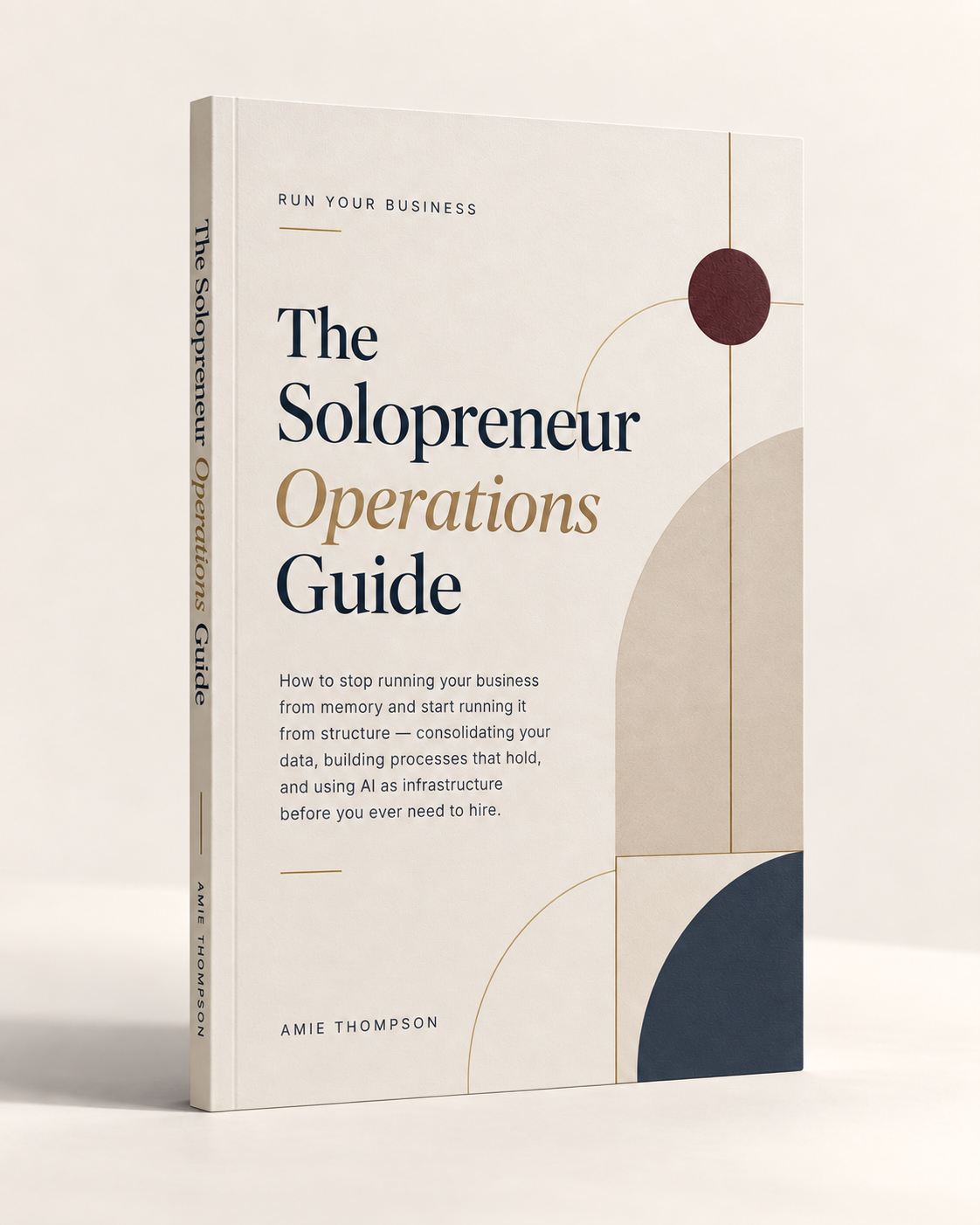
This guide covers the three areas that change how a small business feels to run: consolidating your data so you can see what's happening, building processes that live somewhere other than your head, and integrating AI into your operations so the business does more of the work without requiring more of your time.
It's the foundation of the Command Center, a system designed specifically for solopreneurs who are ready to stop running their business from memory and start running it from structure.
One
Consolidate
Get your business information out of three different apps, your email, and your head and into one place you can use.
Two
Structure
Document what you do repeatedly so it exists somewhere other than your memory and can eventually run without you in the room.
Three
Automate
Use AI as infrastructure to handle operational weight so your thinking goes further while your judgment stays central.
Section 02
Consolidate: See What's Happening
If your business information is spread across your email, your notes app, a spreadsheet, three different tools, and your own memory, you are running on hope and habit.
The first step in building a business that operates from structure is creating a single source of truth: one place where you can see your client information, your revenue, your open tasks, and your follow-ups without having to piece them together from five different sources.
Client and prospect information
Who you're working with, where each relationship stands, what you've promised, and what's pending. If you're tracking this in your inbox or in your head, it needs to move.
Revenue tracking
What came in, what's outstanding, and what you expect next month. If you can't answer these three questions quickly, your financial visibility is a problem.
Open tasks and follow-ups
Everything that's waiting on you, including client deliverables, outreach, and administrative tasks. If it lives only in your head, it will fall through the cracks eventually.
Your offer and delivery process
What you sell, how you deliver it, and what a client experience looks like from start to finish. This is the foundation everything else is built on.
Section 03
Structure: Build Processes Outside Your Head
A process that only exists in your head is a dependency. Every time a client is onboarded, a proposal goes out, or a project wraps up, you're doing the same steps. You just haven't written them down. Every time, you're reinventing a wheel you've already built and introducing the possibility of inconsistency.
Documenting your processes doesn't mean building a corporate operations manual. It means writing down what you do, in the order you do it, so it can eventually run without requiring your full attention every time.
Where to start with process documentation
Start with repetition. Look for the things you do every week, every time you onboard a client, every time you send a proposal, and every time you follow up on an inquiry. Those repetitive tasks are where your systems begin.
For each one, write down the steps you take. Capture the current version rather than the ideal one. That rough draft of a process is worth significantly more than a polished one that never gets built.
Reinventing client onboarding every time
Same experience delivered consistently, every time
Forgetting follow-up steps under pressure
Follow-up happens on schedule, even when you're busy
Can't hand anything off without extensive explanation
Someone else could run it from the documentation
Quality varies depending on your capacity
Quality holds because the standard is defined
Business depends entirely on your availability
Business runs even when you step away
Section 04
AI as Infrastructure
Most people use AI as a one-off tool, such as a faster way to write something or a quick answer to a question. That can be useful, though it does not create operational leverage. The founders who get real value from AI treat it as infrastructure: a layer built into their business that handles the operational weight consistently, whenever the work needs to happen.
Where AI belongs in a solopreneur operation
Communication
Drafting and refining
Client communications, proposals, follow-ups, and onboarding emails. AI removes the blank page and speeds up the first draft while your voice shapes the final version.
Operations
Organizing and summarizing
Meeting notes, project summaries, research synthesis, and decision documentation. AI can support tasks that do not require your judgment.
Decision support
Generating options
AI can help generate options, stress-test assumptions, and surface considerations you might have missed. Use it as a thinking partner while keeping the decision with you.
Keep your judgment central
Your judgment, client relationships, and strategic thinking stay with you. When founders try to automate everything, they can end up with a business that sounds like no one in particular. Use AI for tasks that do not require you so you can show up fully for the ones that do.
Your turn
The Operations Audit
Work through these questions before you build anything. The answers tell you where your biggest operational gaps are and where to start.
Where does my most important business information currently live?
What do I do every week that I've never written down?
What task, if I stepped away for two weeks, would fall apart or slow down?
Where am I spending time on work that doesn't require my judgment?
What's the one thing I could build this month that would make the biggest difference to how my business runs?
The answer to the last question is where you start. Choose the gap you can close this month with the time and energy you have right now.
Section 06
Productivity Systems for a One-Person Operation
Generic productivity advice is designed for someone with a calendar full of meetings and a team to coordinate. Much of it does not apply to a solopreneur, and a lot of it creates more overhead than it removes. A productivity system for a one-person business has one job: make sure the high-value work happens consistently, even when everything else is pulling for your attention.
The three-task rule
On any given day, identify three meaningful actions that move your business forward. Three is enough. This creates momentum without the overhead of a complex task system, and it forces the prioritization work that most people skip.
The three tasks don't have to be big. They have to be the right ones. One revenue-generating action, one visibility or delivery action, and one operational action is a simple template that works for most solo operators.
Protecting your best hours
Every solopreneur has a window, usually two to four hours, when their thinking is sharpest. That window is for work that requires judgment: client work, strategy, offers, and decisions. Give admin, email, and scheduling the remaining time.
Weekly review as a business practice
A 30-minute Friday review changes how a business operates. Ask what got done, what didn't, what's carrying into next week, and what one thing would make the biggest difference in the next seven days. Write it down. Externalizing it gives you perspective the week inside it can't.
The difference between a time problem and a structure problem is important. Most overwhelm is a structure problem. Solving a structure problem with more hours just moves the ceiling.
Section 07
When to Build a System and When to Hire
Most founders hire too early, before they understand what they need someone to do. The result is an expensive hire who is handed a vague role, asked to figure it out, and either underdelivers or leaves within a year. Build clarity and systems first so that when you bring someone in, you know exactly what you're handing off.
Build a system when
The task is repetitive and documentable
If you do it the same way every time, write it down and systematize it before paying someone to do it for you.
The bottleneck is process
If the work is slow because there's no clear path, a better process will move faster than another person on a bad one.
AI can carry the weight
Before paying for a human hour, ask whether AI can handle the task. Drafting, organizing, summarizing, and generating options are strong places to begin.
Hire when
The work requires specialized human judgment
Legal, accounting, and specialized technical work require a person. Hire for those areas first.
The system is built and needs someone to run it
When you have a documented process, onboarding someone becomes manageable. Without it, you're paying someone to figure out what you haven't figured out yet.
Put it into practice
Your 30-Day Operations Starter Plan
You don't need to build everything at once. In 30 days, you can close your biggest operational gap and build the habit of running your business from structure instead of from memory.
Week one
Audit
- Complete the operations audit
- Map where your most important business information currently lives
- Identify which area among clients, revenue, and tasks is most fragmented
Week two
Consolidate
- Move client and revenue information into one accessible place
- Set up a simple task tracking system. A shared document or basic tool works
- Do a 30-minute Friday review at the end of the week
Week three
Document
- Write down the steps for the one process you repeat most often
- Identify one task that doesn't require your judgment and build an AI workflow for it
- Continue the Friday review and notice what's becoming easier
Week four
Refine
- Review the system you built and identify what needs adjustment
- Identify the next process to document
- Plan your next 30 days with what you now know about how your business runs
Being good at your work gets a business started. Running it well is what keeps it going.